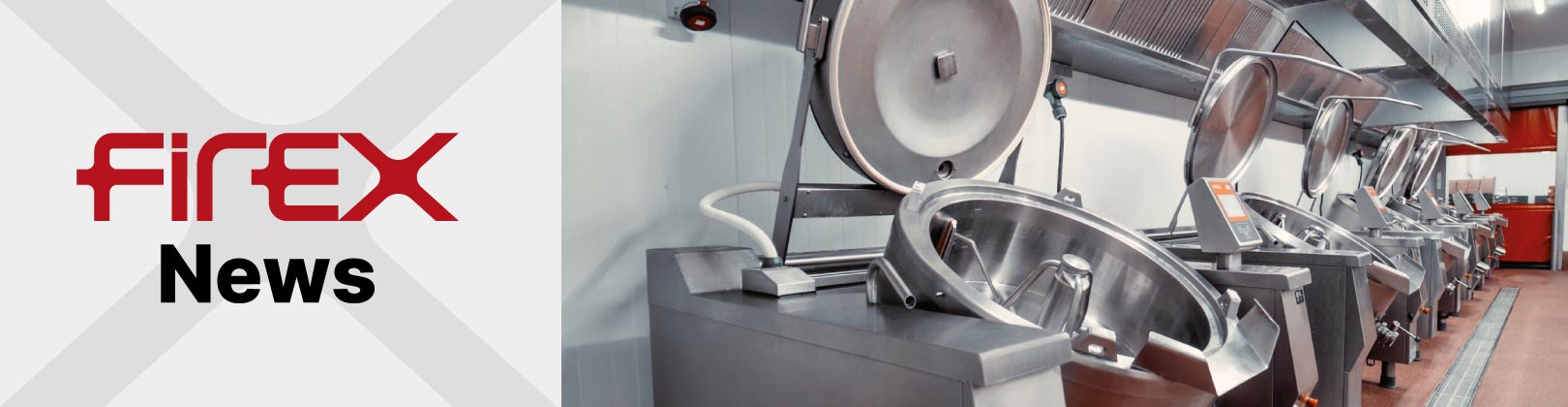
A cooking centre is a place designed to produce meals in a centralized, standardized, and controlled manner. These meals are then distributed to various locations, such as school cafeterias, businesses, hospitals, nursing homes, and community services.
The aim is to combine consistent quality, process control and resource optimisation, with efficient management of production, storage and transport—while ensuring the highest level of safety.
Cooking methods and innovation
Central kitchens must ensure consistency and high volumes without compromising on the quality of the food. Innovation today stands for automation, digital control and optimisation of the hot/cold chain, based on transport requirements.
The most common organisational models include:
- Cook & Serve: production and distribution over short timescales, useful when consumption sites are nearby.
- Cook & Chill: cooking, blast chilling, and then regenerating at the point of consumption; ideal for managing distances and demand peaks.
- Cook & Freeze: for planning production and stocks, using industrial methods and maximising scheduling.
Innovation is not just about “technology”: it also means rethinking the layout and components of the professional kitchen to reduce steps, errors, waste and downtime.
Catering services
Foodservice operations require the utmost attention to ensure operational continuity, compliance with nutritional standards, consistent results, food safety and the ability to handle large volumes.
A well-organised central kitchen is essential for ensuring consistency and quality in recipes and portion sizes across multiple locations. This not only boosts productivity but also simplifies staff training; thanks to kitchen technology, staff can simply follow guided, standardised processes, thereby contributing to greater food safety and more efficient resource management.
However, the challenges may include managing changes in consumer tastes, adapting to constantly evolving regulations and the need for ongoing training for the staff, who must be able to operate increasingly sophisticated equipment. Furthermore, the regulations require strict controls to ensure the highest standards of food safety.
Some examples of catering centres that are using Firex equipment:
- Ristorazione Ottavian: “Knowing that the chef arrives early in the morning, switches on the machine and finds everything in perfect working order is synonymous with the quality we provide for our staff, which is then reflected in the service we offer our customers.”
- Pelin Catering: “Firex equipment helps us cook quickly and hygienically, whilst also reducing our costs.”
- Rivalta Food: “Since we first came across the company in 2015, we have closely followed their developments and appreciated their commitment to making the equipment as efficient as possible. Firex is definitely heading in the right direction.”
- Food Boutique: “We fell in love with them straight away! Firex machines are our full-time colleagues: reliable, precise and always ready to go.”
Food safety in foodservice
In catering, safety means strict control of times, temperatures and procedures, to deliver consistently high-quality meals and ensure correct processing of ingredients. In a cooking centre, food safety is built, for example, by reducing manual operations, separating “dirty/clean” routes, and monitoring critical stages (cooking, chilling, holding, regenerating).
Standardising cooking programs and ensuring traceability of parameters is paramount to ensuring quality and compliance.
Applications and benefits of a cooking centre
The most typical applications of a cooking centre include school canteens, but also hospitals, multi-site businesses and public services. The main benefits are tangible:
- Cost reduction thanks to fewer pieces of equipment and staff across multiple satellite kitchens.
- Centralised services for managing purchasing, prepping and quality control operations in a single location.
- Logistics efficiency by planning production cycles and deliveries.
For many organisations, centralisation means higher perceived quality and reduced management complexity.
Managing cooking centres for school catering
The topic of cooking centres for school canteens is particularly sensitive: meals must be safe, well accepted by students, nutritionally balanced and delivered on time. School catering operations require flexibility to accommodate special diets, allergen-related needs and daily manu variations.
Key points to consider include:
- menu and production planning based on repeatable processes;
- robust procedures for managing special diets and allergens;
- portioning and packaging control;
- organised transport systems to maintain food temperatures and quality until service.
Equipping a cooking centre with automated cooking systems helps ensure that all these requirements are consistently, while providing operators with reliable technological support. The result is a process of continuous improvement that drives the evolution of the cooking centre and delivers tangible gains in operational efficiency and resource management.
How a cooking centre operates and is organised
A cooking centre operates most effectively when workflows are linear, minimising cross-traffic and unnecessary movement. Its organisation should ensure continuous monitoring and effective contamination prevention throughout all stages of production.
In general, the process includes:
- receiving and storing ingredients,
- food prepping,
- cooking and finishing,
- blast chilling and storing, where required
- portioning/packaging,
- dispatch and transportation,
- sanitation procedures and waste management.
The “All Forward” principle (products and operators move progressively through dedicated zones without backtracking) helps reduce hygiene risks, minimize errors, and save time, while improving quality control and overall productivity.
Setting up and running a cooking centre
Eastablishing a cooking centre or hub requires both strategic planning, and operational practicality.
Beyond meeting regulatory requirements, success depends on careful planning and the selection of the right equipment:
- define daily production volumes, target users, facility size, and the model (cook&serve / cook&chill / cook&freeze);
- size production areas and utilities appropriately (including energy, water supply, drainage, and ventilation system);
- design the layout to ensure separated workflows and support an All Forward approach;
- define recipe standards, portioning procedures, and quality control measures;
- implement a maintenance program and staff training plan.
Well-executed design has a long-term impact on costs, often delivering greater savings over time than the initial investment itself.
Equipment in a cooking centre
Modern cooking centres can move beyond the traditional concept of a kitchen made up of numerous single-purpose machines. The “Kitchen of the Future” approach rethinks production layouts by focusing on multifunctional, programmable equipment, reducing footprint, utility connections, and overall operational complexity.
A concrete example is the creation of an efficient production line using just three FIREX machines:
- Figaro: a multifunctional bratt pan designed to perform different cooking methods (braising, sautéing, frying and rapid cooking). It combines versatiliy, speed, and productivity for high-volume production.
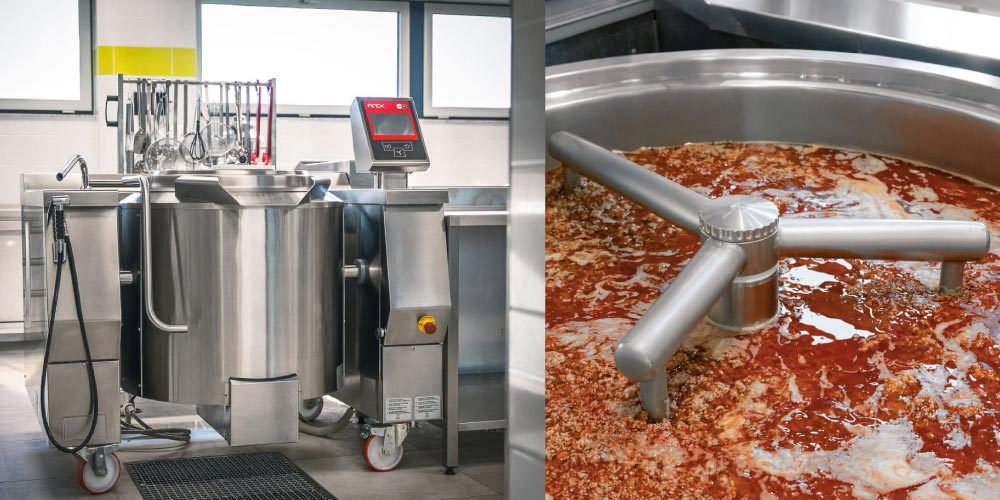
- Cucimix: a professional industrial cooker with an automated mixing system, designed to increase autonomy and ensure consistent results. Its programmable controls allow recipes and cooking cycles to be stored and repeated, reducing manual intervention and process variability.


This “Kitchen of the Future” approach delivers multiple benefits: fewer machines, reduced space, greater standardisation, less dependence on specific manual skills, and a cleaner, more efficient working environment.
FAQ: cooking centre
What is a cooking centre?
A cooking centre is a facility specifically designed for the large-volumes preparation and centralised distribution of meals for canteens, schools, hospitals, corporate or community organisations. The aim is to ensure consistently high standards of quality and safety. Within a cooking centre, recipes are managed as structured production processes, with a strong focus on food safety, traceability, quality assurance, and repeatable results.
What can you do in a cooking centre?
A cooking centre carries out all the activities required to produce meals efficiently on a large scale. These include receiving and storing raw materials, food preparation, batch cooking, chilling or hot holding, portioning and packaging, and the distribution of meals, whether hot or cold, to service locations. In addition, the cooking centre plays a key role in standardising recipes and ensuring food safety, guaranteeing that every meal is prepared following strict protocols. The goal is to maintain production continuity, consistent quality and optimised management of time and resources.
What do you mean by catering service?
A catering service encompasses all the activities involved in the preparation and provision of food and beverages to customers or end users. This may include restaurants, event catering, corporate and school canteens, healthcare facilities, and community services. The service extends beyond food preparation and includes menu planning, hygiene and sanitation management, logistics, portion control, and meal distribution.












